// Field trial · Oak lace bug · Krasnodar Krai
88.9–98.5% on day 7. Eight variants, one control, one drone.
Eight preparations on essential oils against the oak lace bug Corythucha arcuata, applied in the third ten-day period of August by a Pulverex backpack sprayer and by an unmanned aerial vehicle (UAV) — a DJI Agras T-16 with an ultra-low-volume (ULV) sprayer. Efficacy is the reduction in pest numbers against an untreated control, counted on day 1, 3 and 7.
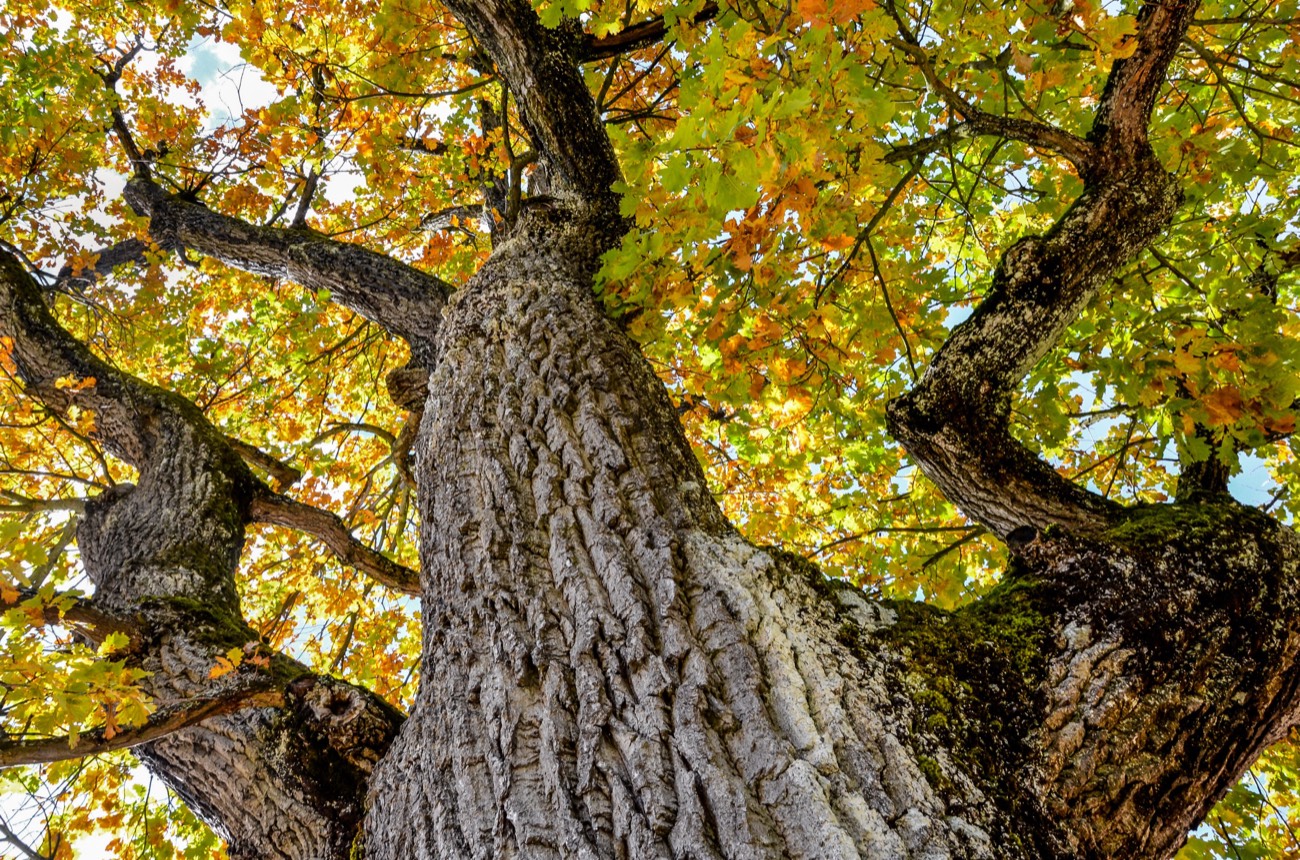
Biostat MK · UAVSeven other variants
| Variant | l/ha | Leaf strip | Day 1 | Day 3 | Day 7 |
|---|---|---|---|---|---|
| Biostat MKUAV, ULV | 3.0 | 26.6 | 90.8 | 98.5 | |
| Coriander oilBackpack | 2.0 | 36.1 | 70.6 | 96.7 | |
| Fir oilBackpack | 2.0 | 70.2 | 87.4 | 88.9 | |
| Fennel oilBackpack | 3.0 | 66.8 | 86.6 | 96.8 | |
| Dill oilBackpack | 3.0 | 51.4 | 79.2 | 95.8 | |
| Chamomile oilBackpack | 2.0 | 40.9 | 75.8 | 94.1 | |
| Biostat MBackpack | 2.0 | 35.0 | 68.2 | 95.4 | |
| Biostat MSBackpack | 2.0 | 76.6 | 76.6 | 94.1 |
Biological efficacy, %: death of adults and larvae against the untreated control. The report gives the month — the third ten-day period of August — but no year, and no plot size or replicate count. Each strip behind a row heals to that row's day-7 figure; fir stops at 88.9% and keeps its stipple.
Eight curves, one per variant, drawn from day 1 to day 7; behind each, a strip of oak leaves healing to that variant's day-7 figure.
An invasion that may exceed 7 million hectares.
Corythucha arcuata Say, the oak lace bug, is an invasive species. In 2016–2020 it spread rapidly across the North-West Caucasus — Krasnodar Krai, the Republic of Adygea, adjoining Stavropol Krai, Rostov Oblast, Karachay-Cherkessia and other regions of Russia. The report's own estimate of the invasion area: it may exceed 7 million ha.
The damage is complete loss of the leaf surface on all oak species. Photosynthesis stops — no CO2 uptake, no O2 release, no normal growth — and with it trophic links, valuable timber and ecological balance are lost irreversibly. The bug also attacks hornbeam, ash, beech, maple, American chestnut, apple, plum and other species.
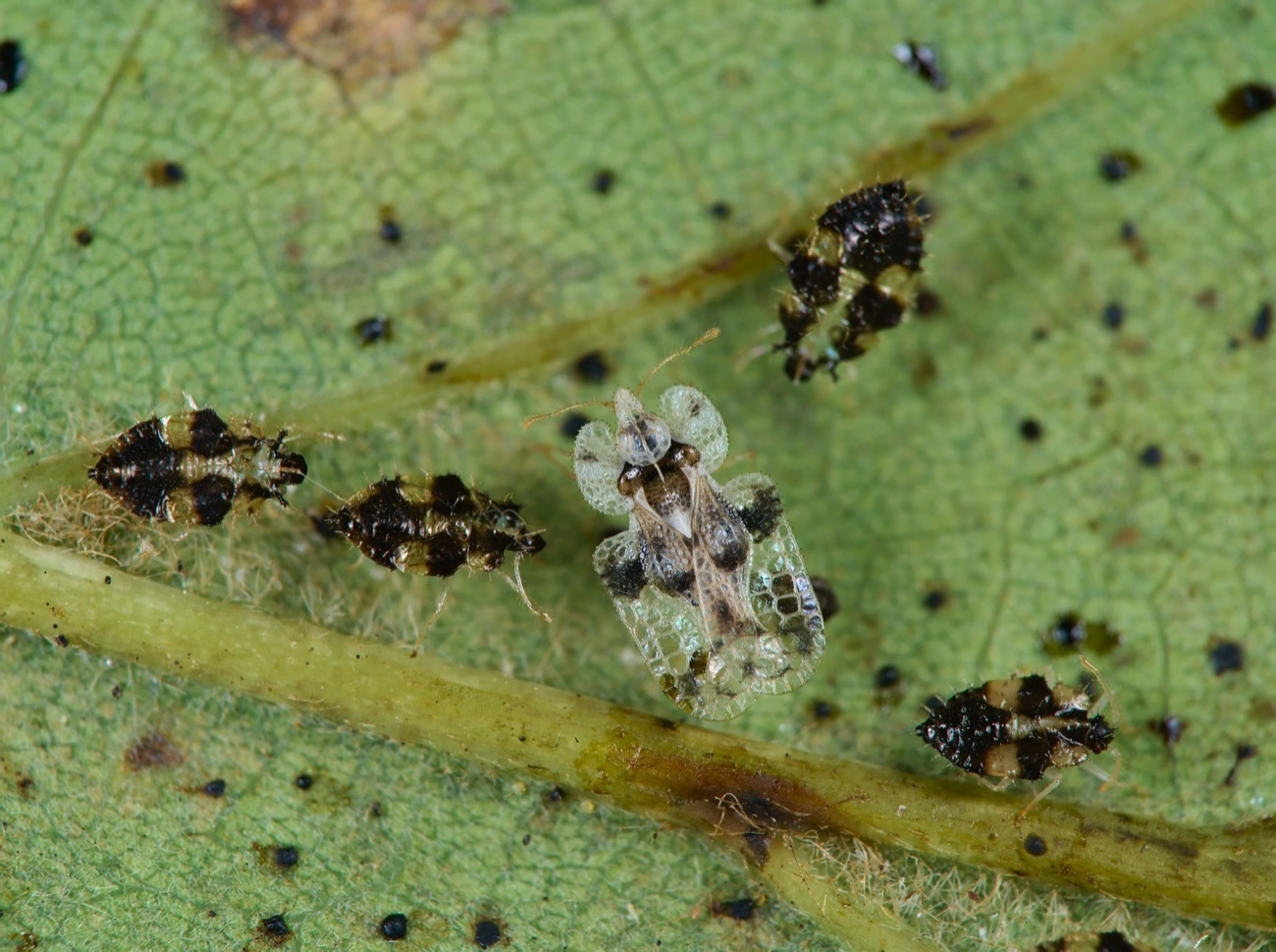
across the North-West Caucasus.
may exceed — the report's estimate.
individuals counted in the trial plots; untreated control 15–30.
3.0 l/ha, dosed to the tree.
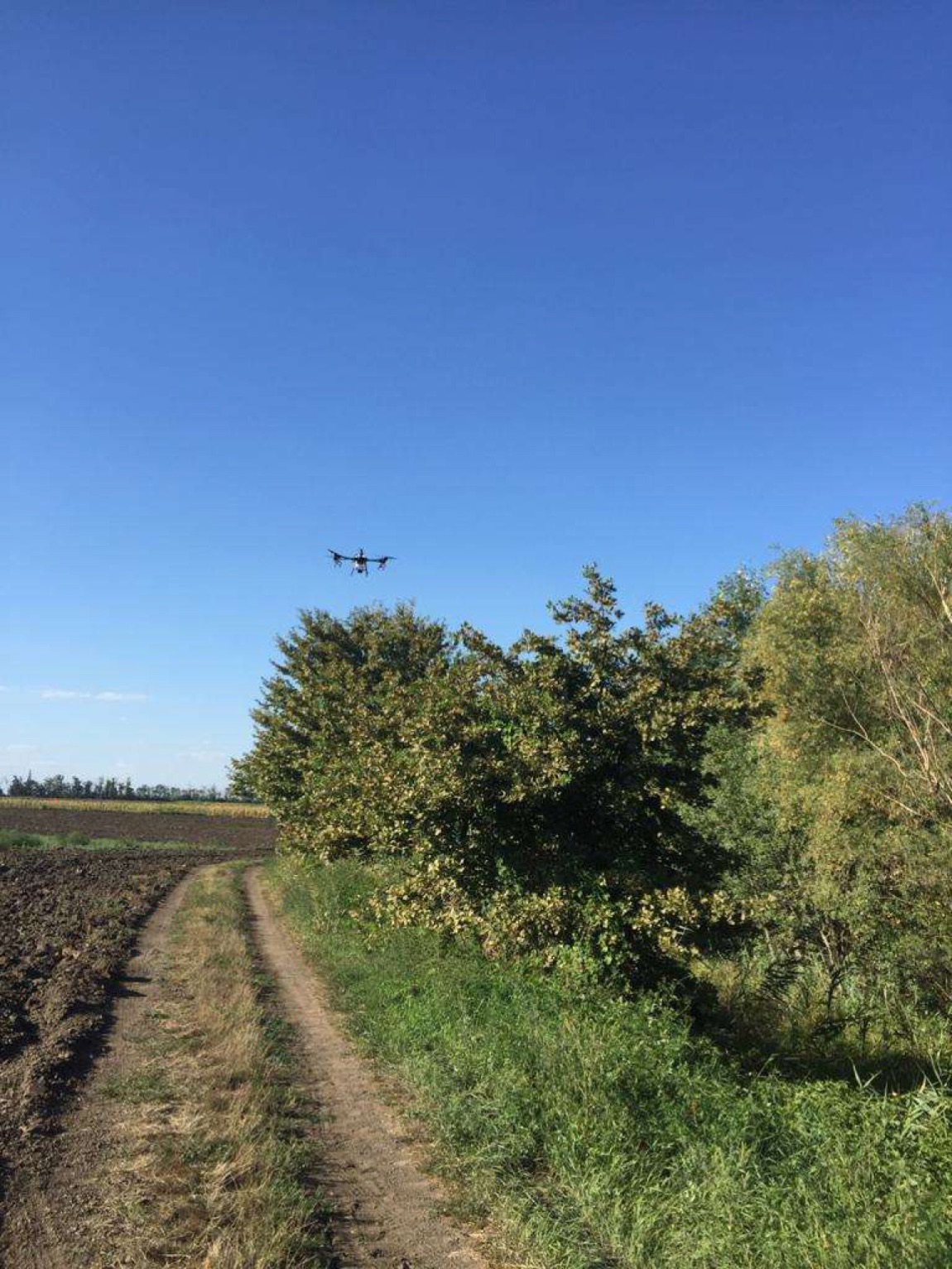
A strip of damaged oak leaves seen from above; a band of mist crosses it and the leaves it has passed begin to heal.
Day 1 · 26.6% behind the pass — Biostat MK, UAV, ULV, 3.0 l/ha
Fig. 2 — photograph, company archive. A spraying drone above the oaks; the band marks the pass.
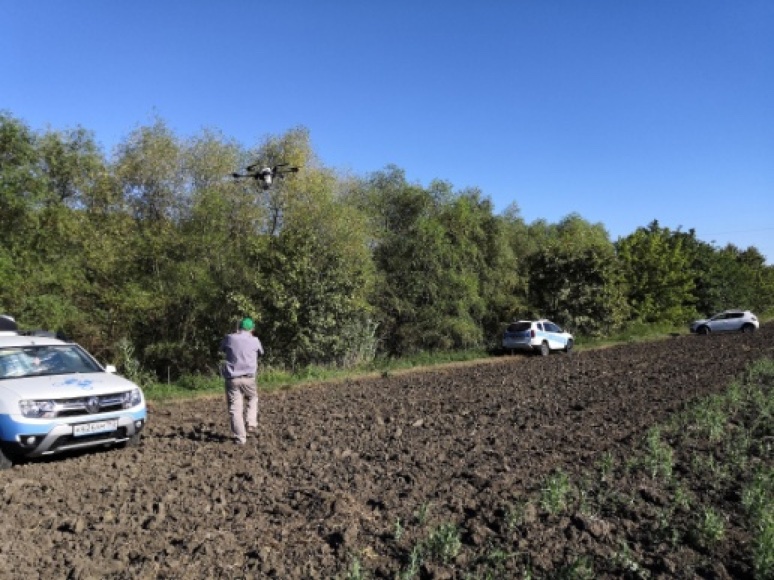
Biostat MK was applied from a DJI Agras T-16 with a ULV sprayer at 3.0 l/ha; the seven other variants with a Pulverex backpack sprayer at 2.0 or 3.0 l/ha. The advantage the report names for the UAV is targeted, dosed spraying of oaks growing in mixed stands and forests. Photosynthetic capacity of the treated oaks was read by multispectral sensing before treatment and 7 and 14 days after.
The company's development work pairs phytosanitary monitoring with treatment — multisensor complexes and ULV spraying from UAVs — for large-scale and small farms alike.
RU 2762422, 10 June 2021.
Patent of the Russian Federation No. 2762422, dated 10 June 2021, covering the composition and its extraction.
“An insecto-acaricidal composition characterised in that it comprises coriander essential oil and α-pinene in a mass ratio from 1:4 to 4:1.”
Federal Research Centre of Biological Plant Protection, Krasnodar.
The trials were run by the institute, led by Vladimir Yakovlevich Ismailov — Candidate of Biological Sciences, leading researcher, head of the Laboratory of Chemical Communication and Mass Rearing of Insects — jointly with BIOZAR LLC. Ismailov is the scientific supervisor of BIOZAR LLC and signed the registration dossier.
The trial report names the institute under its earlier title, the All-Russian Research Institute of Biological Plant Protection; the company deck uses the current one. The same institution.
Moscow Institute of Medical Parasitology, Tropical and Transmissible Diseases — toxicology of the active substance and of the formulation.
Patent RU 2762422, 10 June 2021 — coriander essential oil and α-pinene, mass ratio 1:4 to 4:1.
Oral LD50 4,370–4,490 mg/kg. Hazard class 3.
LD50 is the median lethal dose. The registration dossier reports it for linalool, the main component of the active substance, and for the formulation as a 5% aqueous solution; the formulation is hazard class 3 — moderately hazardous — under GOST 12.1.007, the Russian state standard. Studies per Methodological Guidelines No. 4263-87 (13.03.1987) and No. 4000-85 (04.11.1985); outbred white mice 18–20 g, white rats 180–200 g, rabbits 2.5–3.0 kg.
Active substance — linalool, more than 65% of the oil
- 3,500mg/kgOral LD50, acutemice (5 males, 5 females) — hazard class 3, GOST 12.1.007-88
- > 9,000mg/kgDermal LD50, acutehighest dose tested
- none detectedSkin irritation
Formulation — BIOSTAT, emulsion concentrate
- 4,490mg/kg rats · 4,370mg/kg miceOral LD50, acute, 5% aqueous solutionhazard class 3, GOST 12.1.007-88
- > 2,500mg/kgDermal LD50, acutehighest dose tested
- none on single applicationSkin irritation
- 10%Eye mucosathreshold concentration of the aqueous emulsion for local irritant action
- not requiredExcretion with milknot used on fodder crops or livestock
- ethyl alcoholSolventLD50 5,700 mg/kg, mice; emulsifier OP-10.
- not toxicBees and entomophagesStated in the company’s partner deck; the registration dossier reports no bee-toxicity study.
The company's partner deck states a higher acute-toxicity figure and a blanket safety claim; neither is used on this site. The registration dossier's figures and its hazard class are.
PPE
Personal protective equipment (PPE): protective goggles, GOST 12.4.013-85E; respirator, GOST 12.4.041; rubber gloves, GOST 20010. Safety rules for hazard-class-3 pesticides.
After work
Wash hands and face with soap. Skin: rinse with running water and soap. Eyes, mouth, nose: rinse with running water.
In soil
The product degrades; the dossier reports no harmful residues in soil, water, plant or produce, and no interference with existing crop rotations.
Six documents. Available on request.
The six documents behind the figures on this site:
Ask for the documents- 01
- Registration dossier of BIOSTAT.Composition, physico-chemical data, biology, application, toxicology. Signed by V. Ya. Ismailov, scientific supervisor of BIOZAR LLC, with the company seal.
- 02
- Product description.Two pages: the thirteen efficacy rows, compatibility, rates, the schedule.
- 03
- Field-trial report.Eight preparations against the oak lace bug, day 1, 3 and 7; backpack and UAV application.
- 04
- Partner deck.11 slides: the team, the patent, application by drone.
- 05
- Development directions.The essential-oil plant's six directions.
- 06
- Export contracts.Six contracts, August–November 2021.